

Researching the potential reasons your eyelid hurts and how to treat it is a good place to start, but if irritation, pain, discharge, inflammation, and spasms in one or more eyelids persist, it could be a sign of a serious condition. Whenever you have a change in your vision or eyes, consult your eye doctor to diagnose the condition.
Left untreated, minor pain in your upper eyelids or lower eyelids can quickly grow to the center of your focus. We hope that by the time you’ve read this brief post, you’ve identified the culprit and the following steps to soothe your sore eyelids.
#1 Eyelid Soreness May be Caused by Infection

Often, symptoms escalate quickly, and this condition requires immediate medical attention. If left untreated, orbital cellulitis can damage the optic nerve, cause vision loss or hearing loss, or lead to a blood clot at the base of the brain. Peri-Orbital cellulitis may require a hospital stay and oral or intravenous antibiotics to treat it. In some instances, surgery is necessary to reduce the swelling around the eyelid.
Symptoms of peri-orbital cellulitis
- Painful swelling of the upper and/or lower eyelid
- Possible swelling around the eye, including the eyebrow and cheek
- Limited vision
An eye care professional must determine whether the infection is orbital cellulitis or cellulitis and direct the appropriate treatment plan.
#2 Irritated Eyelids Can be Caused by Allergens
Many of us have experienced seasonal and environmental allergies, which are common causes of eyelid discomfort. The symptoms occur when you’re exposed to allergens that interact with your immune system and cause eyelid irritation. Common allergens include:
- Pollen
- Animal dander
- Dust
- Mold
- Smoke
To avoid soreness and discomfort, avoid the allergens. But, if you cannot avoid them altogether, you can also take antihistamines or decongestants to help minimize allergy symptoms.
#3 Eyelid Soreness May Be Caused by Inflammation
Blepharitis is an eyelid inflammation around the base of the eyelashes. The American Academy of Ophthalmology describes blepharitis symptoms as eyelids that are “… red, swollen, or feel like they are burning.” Blepharitis can contribute to or exacerbate dry eye problems.
Remedies include warm eyelid compresses and eyelid scrubs to eliminate excess oil and bacteria on the eyelids that can lead to inflammation. In chronic cases, your eye doctor may prescribe antibiotics.

Conjunctivitis: causes and symptoms
Another inflammatory condition that can cause eyelid soreness is conjunctivitis. This is an inflammation of the lining of the eyeball and/or the eyelids, often resulting in eyelid swelling and pain. Conjunctivitis can be caused by bacteria or viruses (often called “pink eye”), allergies, eye irritants, or systemic inflammation.
Common symptoms include a yellow or green discharge from the eye that causes the eyelids to stick together during sleep. The eye and eyelid feel irritated and gritty at times. If a virus causes the condition, it is highly contagious.
Conjunctivitis treatments
The condition often clears up on its own, but the Centers for Disease Control (CDC) suggests seeing a doctor immediately if you have:
- Moderate to severe pain in your eye
- Sensitivity to light
- Blurred vision
- Intense redness in the affected eye
- A weakened immune system, and are under treatment for cancer or HIV
- A pre-existing eye condition
- Symptoms that are getting worse
Your eye doctor may give you oral antibiotics, antibiotic eye drops, or allergy medicine to treat conjunctivitis. If the symptoms don’t improve within 24 hours of beginning antibiotic treatment, the CDC recommends contacting your doctor.
#4 Eyelid Soreness Caused by a Sty
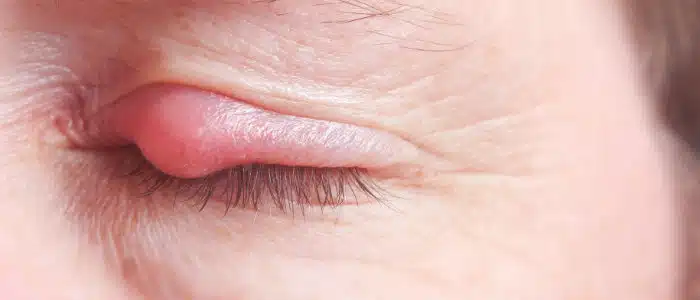
A sty is a focal inflammation causing a lump in the eyelid, often near the eyelashes. It can be caused by a blocked oil duct that becomes infected with bacteria, becomes inflamed, and becomes painful. This bump at the edge of your eyelid usually lasts a few days, then bursts and heals on its own. Some sties require medical care.
A chalazion, like a pimple, is caused by a blocked oil gland in the eyelid and usually develops on the back of the eyelid. In a chalazion, the pain fades, but the bump persists. Medical intervention may be required if the pimple doesn’t rupture on its own – especially if it’s on the inside of the eyelid.
Treating a sty or chalazion
Styes and chalazia are not dangerous and usually don’t affect eyesight. However, in some cases, an infection can develop around a stye or chalazion, requiring antibiotic treatment. To diagnose eye infections, it is always best to contact an eye doctor.
Usually, a warm compress applied several times a day at home can help the condition improve; if it doesn’t, your eye doctor may prescribe antibiotics or minor surgical intervention.
#5 Eyelid Soreness Caused by Dry Eyes
Although this eye condition affects the eyeball, some individuals with dry eyes may experience heavy, irritated eyelids.
It’s not surprising that the causes of dry eye have to do with the moisture content of the eyes. Maybe there are too few tears, an imbalance of nutrients in tears, so they don’t moisturize the eyeball properly, or tears evaporate too rapidly. Some remedies include lubricating eye drops or gels, using a humidifier, and taking breaks from the computer screen.