Eye Healthy Foods: Best Foods for Healthy Eyes in Prescott Valley, Arizona
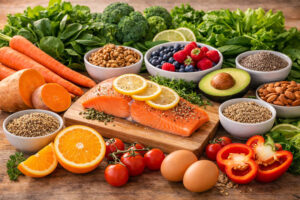
Eye-healthy foods make it easier to support your vision every day, because the nutrients your eyes use most show up in normal grocery-store meals. The best approach is simple: eat more colorful plants, add omega-3-rich fish when you can, and include a few “power foods” like leafy greens, eggs, and nuts. Johns Hopkins notes that nutrients such as vitamins A, C, and E, lutein and zeaxanthin, and omega-3 fatty acids support eye health in different ways.
Your eyes are an active tissue. They use oxygen, are sensitive to light, and have delicate cells that can be affected by inflammation and aging. That is why nutrition often focuses on antioxidants and healthy fats. Johns Hopkins explains that antioxidants help reduce damage from oxidation, a process linked to cell aging, and that omega-3 fatty acids have anti-inflammatory properties and can help with dry eye symptoms.
You do not need to chase a “superfood” list. You just need a few consistent habits.
The Key Nutrients behind Eye-Healthy Foods
Lutein and zeaxanthin
These carotenoids are concentrated in the retina; food sources include leafy greens such as spinach and kale. Easy adds: spinach in eggs, kale in a salad kit, frozen greens in smoothies.
Omega-3 fatty acids
Omega-3s support eye function and have anti-inflammatory properties, and food sources include salmon, sardines, flaxseed, chia seeds, and walnuts. Easy adds: canned salmon, chia in yogurt, walnuts on oatmeal.
Vitamin A
Vitamin A supports the retina and photoreceptors, and Johns Hopkins lists both animal sources and plant foods that your body can convert into vitamin A. Easy adds: carrots, sweet potatoes, spinach, eggs.
Vitamin C
Vitamin C is highly concentrated in the fluid in front of the lens, and it is thought to play an antioxidant role in cataract development. Johns Hopkins lists common food sources like peppers, oranges, broccoli, and kale. Easy adds: citrus, bell peppers, broccoli.
Vitamin E
Vitamin E helps protect fatty acids from oxidation, and Johns Hopkins lists almonds, sunflower seeds, and avocados as sources. Easy adds: almonds as a snack, avocado on toast, and sunflower seeds in salads.
Zinc and selenium
Zinc is one of the nutrients often discussed for eye health, with food sources including shellfish and red meat, and also notes vitamins A, C, and E as part of the bigger picture.
Best Eye-Healthy Foods to Put on Your Plate
You do not have to eat all of these every day. Think of them as a rotating lineup.
Leafy greens
Spinach, kale, and chard are strong sources of lutein and zeaxanthin.
Try this: add a handful of spinach to pasta sauce, soups, or scrambled eggs.
Fatty fish
Salmon, sardines, and mackerel are rich in omega-3s that support eye health and can help with dry eye symptoms.
Try this: salmon tacos, sardines on toast, or a simple salmon salad.
Eggs
Egg yolks are often mentioned as a rich source of lutein and zeaxanthin.
Try this: two-egg breakfast, or chopped egg on a salad.
Colorful fruits and vegetables
Citrus, peppers, broccoli, and berries help build an antioxidant-heavy plate. Johns Hopkins lists several sources of vitamin C, including peppers, oranges, broccoli, and kale.
Try this: keep frozen berries in the freezer, and sliced bell peppers in the fridge.
Nuts and seeds
Almonds, sunflower seeds, chia, flax, and walnuts are easy add-ons for vitamin E and omega-3 support.
Try this: chia pudding, walnuts on oatmeal, sunflower seeds on salad.
Sweet potatoes and carrots
These foods support vitamin A intake through plant compounds your body can convert. Johns Hopkins lists carrots among food sources that support vitamin A.
Try this: roasted sweet potato wedges or carrots with hummus.
Eating for your eye health is easier than you think
Most people assume “eating for eye health” means a strict diet. It does not. The easiest plan is built on swaps you can repeat.
The 3-step “easy plate” method
Pick one color: leafy greens, peppers, berries, carrots, or broccoli.
Add one protein: eggs, beans, chicken, salmon, or tuna.
Add one healthy fat source, such as olive oil, avocado, nuts, or seeds.
That is it. If you do that most days, you are already eating more eye-healthy foods.
A simple grocery list for the week
spinach or kale (fresh or frozen)
eggs
canned salmon or tuna
bell peppers
oranges or berries
sweet potatoes or carrots
almonds or walnuts
chia or flax
A One-Day Meal Example Built Around Eye-Healthy Foods
Breakfast: eggs with spinach, orange on the side Lunch: tuna or salmon salad with peppers, olive oil, and greens Snack: almonds, carrots, and hummus Dinner: roasted sweet potatoes, broccoli, and a protein you like Dessert: berries
Nothing fancy, just repeatable.
Should you Take Eye Supplements?
Food-first is the best default. Supplements can be helpful for specific people with specific conditions, but they are not one-size-fits-all.
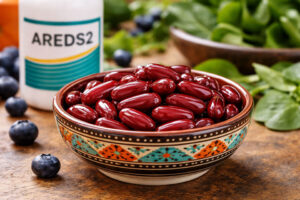
The National Eye Institute explains that AREDS and AREDS2 studied supplements for age-related macular degeneration, and that achieving high levels of vitamins and minerals can be difficult through diet alone, which is why the trials focus on supplement formulations for the right patients.
If you are thinking about supplements, it is smart to talk with your eye doctor first, especially if you smoke, take blood thinners, or have other health conditions.
When Food Helps, and When You Still Need an Eye Exam
Eye-healthy foods support your long game, but they do not replace medical care. If you have:
Eye-healthy foods are foods that are rich in nutrients your eyes use, like lutein and zeaxanthin, vitamins A, C, and E, and omega-3 fats.
Do carrots really help your eyes?
Carrots can help support vitamin A intake, which plays a role in retina function and low-light vision. They are helpful, but they are only one piece of the puzzle.
What foods help with dry eye?
Omega-3-rich foods like salmon, sardines, flaxseed, chia seeds, and walnuts are often highlighted because omega-3s have anti-inflammatory properties and can help with dry eye symptoms.
Do I need to eat these foods every day?
No. Consistency matters more than perfection. Aim for a mix throughout the week, including leafy greens and one omega-3 option each day.
Are supplements better than food?
Food is the best foundation. Supplements may be recommended for certain patients, for example, people with specific stages of age-related macular degeneration, which the National Eye Institute has studied through AREDS and AREDS2.
What is the easiest first step if I want to eat for my eye health?
Start by adding one leafy green and one colorful fruit or vegetable per day, then build from there. It is a simple way to increase intake of lutein, zeaxanthin, and vitamins without overthinking it.
Can eye-healthy foods prevent cataracts or macular degeneration?
A healthy diet supports overall eye health, and many of the nutrients discussed support antioxidant function. Your personal risk depends on age, genetics, smoking history, and medical conditions, so an eye exam matters.
When should I see an eye doctor about my vision?
If you notice changes in vision, have diabetes, or have a family history of eye disease, a comprehensive exam is the safest next step.
To provide the best experiences, we use technologies like cookies to store and/or access device information. Consenting to these technologies will allow us to process data such as browsing behavior or unique IDs on this site. Not consenting or withdrawing consent, may adversely affect certain features and functions.
Functional
Always active
The technical storage or access is strictly necessary for the legitimate purpose of enabling the use of a specific service explicitly requested by the subscriber or user, or for the sole purpose of carrying out the transmission of a communication over an electronic communications network.
Preferences
The technical storage or access is necessary for the legitimate purpose of storing preferences that are not requested by the subscriber or user.
Statistics
The technical storage or access that is used exclusively for statistical purposes.The technical storage or access that is used exclusively for anonymous statistical purposes. Without a subpoena, voluntary compliance on the part of your Internet Service Provider, or additional records from a third party, information stored or retrieved for this purpose alone cannot usually be used to identify you.
Marketing
The technical storage or access is required to create user profiles to send advertising, or to track the user on a website or across several websites for similar marketing purposes.